Design Thinking is a human-centered problem-solving framework that transforms how Learning Experience Designers create educational programs — emphasizing empathy, ideation, and experimentation over assumptions and static plans.
What is Design Thinking?
Design Thinking is a problem-solving framework involving: understanding learner needs, ideating creative solutions, prototyping, and testing. For Learning Experience Designers, it provides a structured yet flexible approach to innovate beyond traditional instructional models, centering the learner's journey and experience.
The Five Stages of Design Thinking in LXD
(Based on Laura Fletcher’s “Design Thinking for Training and Development”)
Empathize
Gaining a deep understanding of the learners — their backgrounds, motivations, challenges, and environments. Goes beyond basic learner analysis to grasp the full context of their experience.
- Conduct interviews: Engage with actual learners to understand their perspectives
- Create personas: Develop learner personas representing different audience segments
- Observation: Spend time observing learners in their natural environments
- Empathy mapping: Visualize learner needs, thoughts, emotions, and motivations
- Journey mapping: Plot the learner's journey to understand various touchpoints
- Focus groups: Facilitate discussions with groups of learners for diverse insights
Define
Articulate the learning problem with clarity and precision — setting clear, focused goals and objectives. The definition is user-centered, ensuring it directly addresses learners' needs and contexts.
- Problem statement: Articulate the learning challenge in a clear, concise statement
- Needs analysis: Determine the gap between current and desired performance
- Learner goals: Identify what learners aim to achieve
- Prioritize challenges: Identify and rank key obstacles to learning
- Scope definition: Clearly define the scope of the learning project
Ideate
Generating a wide range of creative solutions. Encourages thinking outside traditional educational paradigms and exploring innovative approaches — quantity before quality.
- Brainstorming sessions: Collaborative brainstorming for creative solutions
- Mind mapping: Use mind maps to explore and connect ideas
- SCAMPER technique: Apply SCAMPER (Substitute, Combine, Adapt, Modify, Put to another use, Eliminate, Reverse)
- Design workshops: Organize workshops with cross-functional teams
- Storyboarding: Create storyboards to visualize ideas
- Rapid prototyping: Quickly create basic versions of ideas for early testing
Prototype
Transforming abstract ideas into tangible forms — draft versions of learning materials, pilot programs, or mini-modules. The emphasis is on speed: build just enough to learn from.
- Mockups: Create visual or digital mockups of course materials
- Interactive prototypes: Develop clickable prototypes for digital courses
- Role-playing: Simulate learning scenarios to test ideas
- Iterative design: Continually refine prototypes based on feedback
- Pilot programs: Launch small-scale pilots to test in real-world settings
- Low-fidelity prototypes: Start simple to test concepts quickly
Test
Testing and evaluation of prototypes in actual educational settings. Feedback is gathered, solutions are refined, and the cycle repeats — Design Thinking is inherently iterative.
- Real-world testing: Test prototypes in actual learning environments
- User feedback: Gather detailed feedback from test participants
- A/B testing: Compare different versions to see which performs better
- Iterative improvement: Refine solutions based on test results
- Performance metrics: Measure how well the solution meets learning objectives
- Usability testing: Ensure the learning experience is user-friendly and accessible
Facilitating Design Thinking as a Learning Experience Designer
The Learning Experience Designer plays a dual role in Design Thinking: designing the process and facilitating the people through it. Key facilitation skills include:
- Foster empathy: Deeply understand the learner’s perspective to identify real needs
- Build rapport with the audience: Connect with learners for a more engaging environment
- Manage tough questions or attendees: Handle challenging situations gracefully
- Encourage collaboration: Promote idea-sharing and teamwork among stakeholders
- Adapt and iterate: Be flexible, willing to modify approaches based on feedback
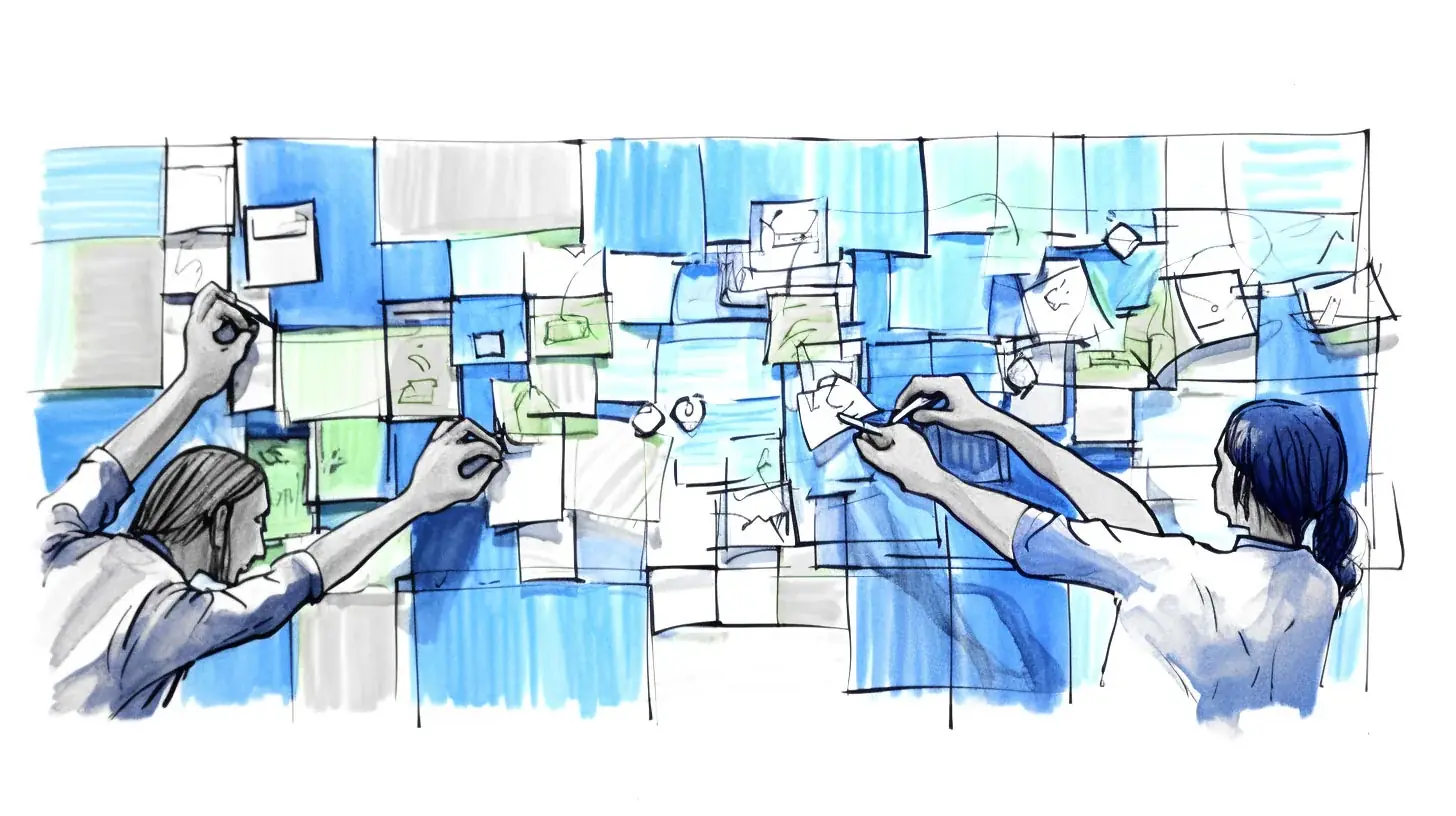
- Use creative problem-solving techniques: Brainstorming with sticky notes, sketching, manipulative verbs
Key Questions Answered
The most commonly asked questions about this topic, concisely answered.
- Design Thinking is a human-centered problem-solving framework that LXDs use to create learning programs grounded in deep learner empathy rather than assumptions. It involves five iterative stages — Empathize, Define, Ideate, Prototype, and Test — and prioritizes experimentation and rapid feedback over upfront comprehensive planning.
- Empathize: Deeply understand learners' backgrounds, motivations, challenges, and environments through interviews, observation, and empathy mapping.
- Define: Articulate the learning problem with precision based on empathy research.
- Ideate: Generate a wide range of creative solutions without judgment.
- Prototype: Build rough, fast versions of ideas to make them tangible and testable.
- Test: Gather feedback from real learners, refine, and iterate.
- ADDIE follows a sequential process with thorough upfront analysis before design begins. Design Thinking is more iterative and exploratory — it embraces ambiguity, encourages rapid prototyping early in the process, and prioritizes learner empathy over systematic needs analysis. Design Thinking is better suited to innovative or ill-defined problems; ADDIE suits well-scoped, stable projects.
- The Empathize stage involves genuinely understanding learners as people — not just defining their skill gaps. Methods include interviews, observation, empathy maps, and learner journey mapping. It is the most important stage because all subsequent design decisions are only as good as the understanding of the learner they are built on. Skipping or rushing empathy leads to solutions that solve the wrong problem.
- A prototype is a rough, quick, low-fidelity version of a design idea created to learn from, not to deliver. It might be a hand-drawn storyboard, a clickable mockup, or a 15-minute pilot module. Its purpose is to fail fast and cheaply — collecting feedback that refines the design before significant resources are invested in full production.
- No. Design Thinking is explicitly non-linear and iterative. Designers frequently move back to Empathize after testing reveals that the problem was misunderstood, or return to Ideate after a prototype fails. The stages are a flexible framework, not a fixed sequence. This iterative quality is what makes it well-suited to complex, human-centered design challenges.
- Design Thinking is best when: the learning problem is not yet clearly defined, learner needs are poorly understood, the goal is to create an innovative experience (not just deliver content), or previous training solutions have failed and the root cause is unclear. It is less suited when requirements are well-defined, timelines are fixed, and systematic production is the priority.
- Common ideation tools include brainstorming (divergent idea generation), mind mapping (connecting related ideas), the SCAMPER technique (Substitute, Combine, Adapt, Modify, Put to another use, Eliminate, Reverse), design workshops with cross-functional teams, and storyboarding. The goal is quantity over quality — evaluate ideas only after generating as many as possible.
- Design Thinking builds learner involvement into every stage: interviews and observations during Empathize, co-design workshops during Define and Ideate, usability testing of prototypes during Prototype and Test. This participatory approach ensures solutions reflect real learner needs rather than assumptions — and often produces higher engagement because learners feel ownership of the resulting experience.
- Treating Design Thinking as a one-time process rather than a mindset. Another frequent mistake is rushing through or skipping the Empathize stage because it feels like it delays 'real work' — leading to well-designed solutions for the wrong problem. Design Thinking only delivers its value when the empathy research is genuine and the iterations are genuine rather than performative.
- Design Thinking is a problem-framing methodology — it helps you discover the right problem to solve through empathy and ideation. Agile is a project management approach — it helps you build solutions iteratively with frequent feedback cycles. They complement each other well: use Design Thinking to define the learning challenge, then Agile sprints to develop and refine the solution.
- Yes, at several stages. AI can analyze learner data for the Empathize stage, generate diverse solution ideas during Ideation, rapidly produce content prototypes for the Prototype stage, and help analyze test feedback. However, the human skills of genuine empathy, creative judgment, and in-person observation remain essential — AI augments Design Thinking but cannot drive it.