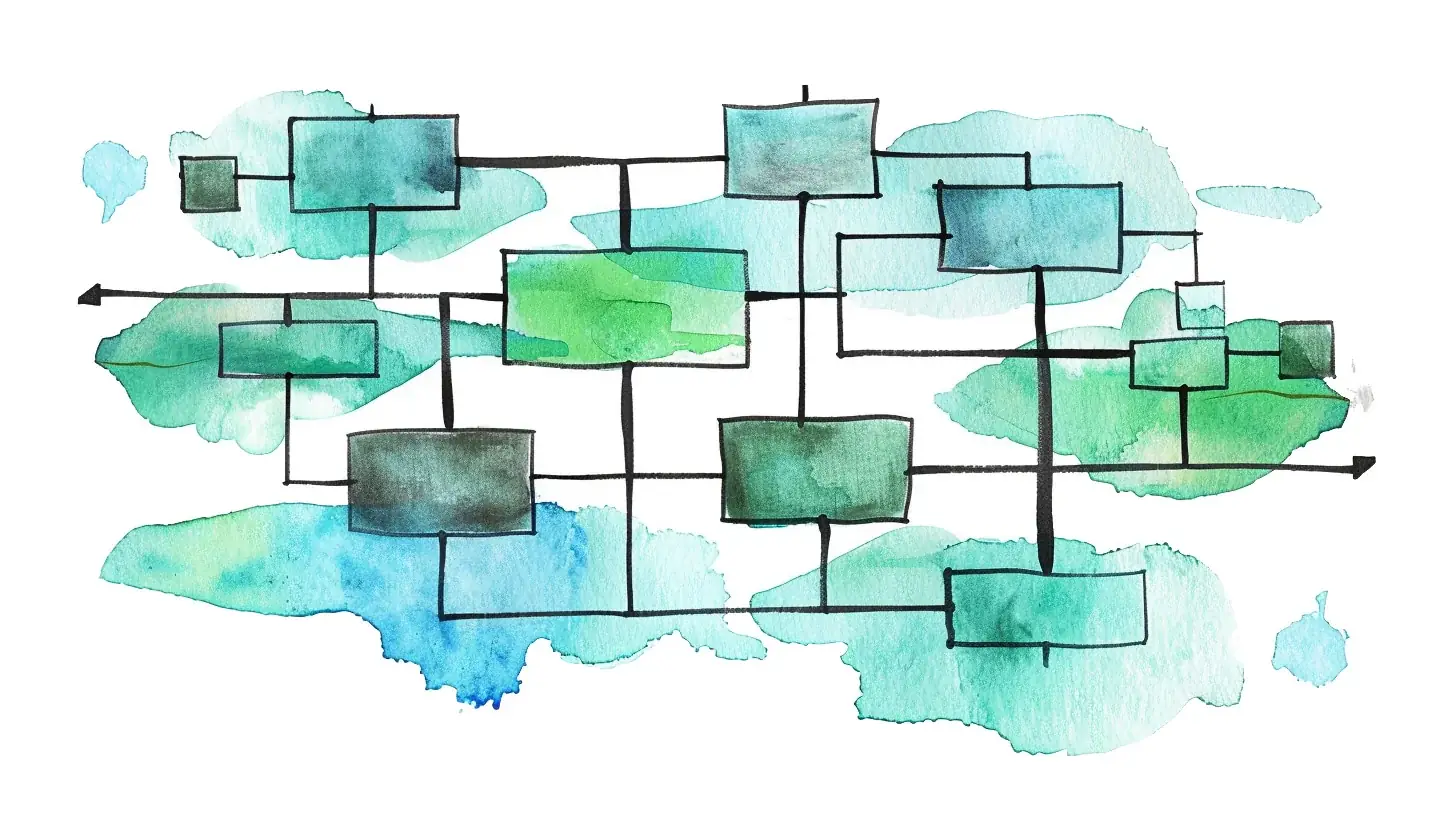
The Four-Component Instructional Design (4C/ID) model, developed by Jeroen van Merriënboer in the 1990s, provides a systematic approach for designing educational programs that teach complex skills or professional competencies — emphasizing whole-task learning experiences that maintain the relationships between different components, rather than breaking them into isolated fragments.
The Four-Component Framework
Learning Tasks
The backbone of the educational program — whole, meaningful activities that closely mirror real-world situations. Learning tasks progress from simple to increasingly complex levels, show high variability to promote transfer, and include diminishing scaffolding support as learners gain expertise.
Learning tasks address both non-routine skills (requiring problem-solving and reasoning) and routine skills (performed consistently). High variability across tasks is crucial — they must differ on all dimensions where real-life tasks also differ.
Supportive Information
Helps students perform the non-routine aspects requiring problem-solving, reasoning, and decision-making. Often called "the theory," this includes domain models describing how the task domain is organised and systematic approaches to problem-solving.
This information is identical for all learning tasks at the same complexity level and remains available throughout the learning process. Supports construction of rich cognitive schemas through conceptual models (what is this?), structural models (how is this built?), and causal models (how does this work?).
Procedural Information
Provides just-in-time support for the routine aspects of learning tasks — those elements always performed the same way. Consists of how-to instructions, step-by-step guidance, and corrective feedback delivered precisely when learners need it.
Key principle: timing — presented when learners first encounter a particular routine aspect, then gradually fades as they develop mastery.
Part-Task Practice
Provides additional focused practice for routine aspects that need to reach very high levels of automaticity. Only necessary when learning tasks don't provide sufficient repetition.
Progression: accuracy → under increasing time pressure → under time-sharing conditions (performing the routine alongside other tasks).
Map each aspect of the skill as either recurrent (done the same way every time → procedural information + part-task practice) or non-recurrent (requires judgement → supportive information). This split drives the whole blueprint.
Key Principles
Whole-Task Approach
Learning through complete, authentic tasks rather than isolated skill components. Ensures learners understand how different elements work together in real performance conditions — from the very first task.
Simple-to-Complex Sequencing
Learning tasks carefully sequenced from simple to increasingly complex levels using simplifying conditions or backward chaining. Prevents cognitive overload while building expertise progressively.
Scaffolding and Support
Graduated support that diminishes as learners gain expertise: worked examples, completion tasks, process guidance, and modelling. The goal is independence — support that never fades produces learners who can’t perform unaided.
Variability for Transfer
High variability across learning tasks promotes flexible expertise that transfers to new situations. Tasks must differ on all dimensions where real-life tasks also differ.
Think of it as a staircase of sawtooths: support resets high at the start of each task class, then fades to zero before stepping up. Complexity rises across classes; support oscillates within them.
Related Theories
The 4C/ID model draws on and connects to several foundational learning theories:
- Cognitive Load Theory: Organises learning tasks from simple to complex, managing working-memory demands at every level
- Constructivist Learning Theory: Emphasises active learning through meaningful, authentic experiences
- Experiential Learning Theory: Guides learners through authentic tasks encouraging reflection and application
- Action Mapping Methodology: Both focus on performance-based learning design with real-world task analysis as the starting point
Key Questions Answered
The most commonly asked questions about this topic, concisely answered.
- The 4C/ID (Four-Component Instructional Design) model is a framework developed by Jeroen van Merriënboer in the 1990s for designing training programs that develop complex professional skills. It organizes instruction around four components: Learning Tasks, Supportive Information, Procedural Information, and Part-Task Practice. Its defining principle is whole-task learning — learners work on complete, authentic tasks from the beginning rather than isolated skill fragments.
- Jeroen van Merriënboer, a Dutch educational psychologist and professor at Maastricht University, developed the 4C/ID model in the 1990s. It was designed specifically for training complex cognitive skills — in contrast to earlier frameworks that were better suited to simpler, more routine learning.
- Learning Tasks: Whole, authentic tasks progressing from simple to complex with diminishing scaffolding.
- Supportive Information: Conceptual and theoretical knowledge (mental models, domain structure) that supports non-routine problem-solving and decision-making.
- Procedural Information: Just-in-time step-by-step guidance for the routine, recurrent parts of tasks — fades as learners gain automaticity.
- Part-Task Practice: Focused repetition for specific routine skills that require very high automaticity but don't get enough practice through learning tasks alone.
- Supportive Information supports the non-recurrent, judgment-based aspects of a task — it provides mental models, domain knowledge, and problem-solving strategies that are always available and do not fade. Procedural Information supports the recurrent, routine aspects — it is delivered just-in-time, specific to the step being performed, and gradually withdrawn as the learner develops automaticity.
- Use 4C/ID when the learning goal involves complex professional competencies — skills that require integrating multiple sub-skills, judgment, and real-world problem-solving simultaneously (e.g., medical diagnosis, engineering design, financial advising, crisis management). ADDIE and SAM are general-purpose frameworks; 4C/ID is purpose-built for complex skill acquisition and transfer.
- Whole-task learning means that from the very first training activity, learners work on a complete, meaningful task rather than isolated components. Even simplified early tasks retain the full structure of the target performance. This preserves the relationships between sub-skills and ensures learners understand how parts function together — which is essential for transfer to the real job.
- Learning tasks are organized into task classes ordered from simplest to most complex, using simplifying conditions or backward chaining. Within each task class, scaffolding starts high (worked examples, completion tasks, process guidance) and systematically fades to zero as learner expertise develops. Complexity then steps up for the next task class — producing the characteristic 'sawtooth' support pattern.
- Part-task practice provides additional repetition for specific routine skills that must reach very high automaticity (e.g., touch-typing in a data entry role, instrument calibration in a lab) but do not receive enough practice through whole learning tasks alone. It is not always required — only when learning tasks provide insufficient repetition for a skill that needs to become fully automatic.
- 4C/ID addresses cognitive load by carefully sequencing tasks from simple to complex (managing intrinsic load), providing supportive information in well-organized formats (reducing extraneous load), and using just-in-time procedural information that does not require learners to hold procedures in working memory while also performing the task. Scaffolding fades as expertise grows, keeping total load within manageable limits throughout the program.
- 4C/ID is especially well suited to professions requiring complex, integrated competencies such as medicine, nursing, aviation, engineering, law, financial advising, teaching, and emergency services. It has also been applied to software development training, management development, and any domain where professionals must exercise flexible judgment across highly varied real-world situations.
- Gagné's Nine Events describe how to structure a single lesson for effective learning. 4C/ID operates at the curriculum level — designing an entire training program for complex skill acquisition. Gagné can be used within 4C/ID to structure individual learning tasks, but 4C/ID addresses the broader challenge of how tasks are sequenced, scaffolded, and supported across the full program.
- 4C/ID programs require more upfront design time than simpler frameworks because of the skill decomposition, task class sequencing, and scaffolding design involved. A typical corporate program may require 4–8 weeks of design before development begins. The investment pays off in programs that produce genuine competence and transfer — making it most worthwhile for high-stakes, complex skill domains.