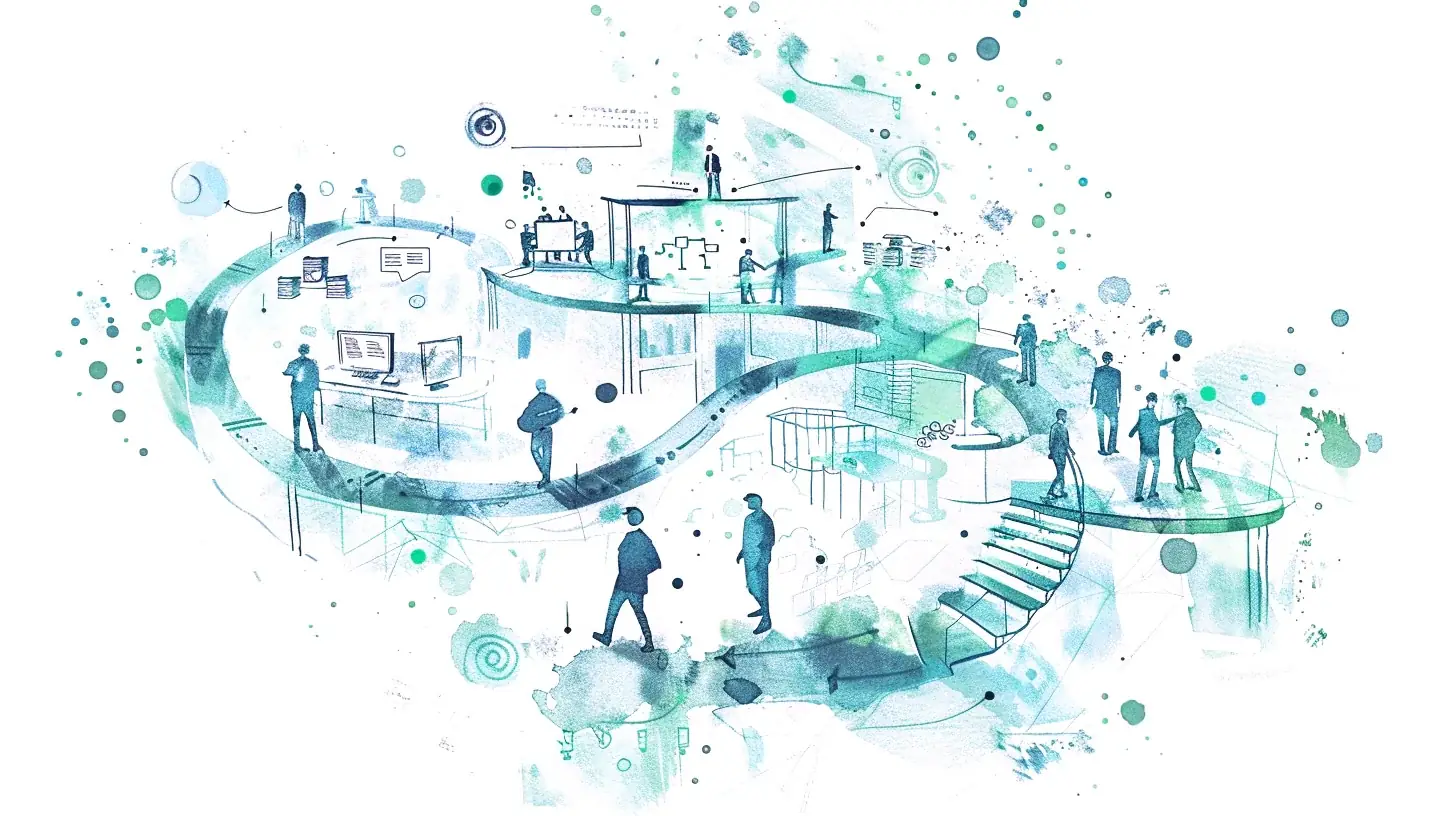
Social learning happens between people, and Questiory is built to make those moments richer, more inclusive, and more intentional. This guide shows you how to design question-driven experiences that turn passive audiences into active, collaborative learners.
Why social learning belongs in your design toolkit
Learning is inherently social. Long before formal training existed, people learned by watching, asking, and making sense of experiences together. Albert Bandura’s Social Learning Theory established that observation and peer interaction are among the most powerful mechanisms for acquiring and applying new knowledge.
Yet most workplace learning still treats people as isolated learners: a course to complete, a video to watch, a module to click through. Questiory offers a different starting point: one where the group is the learning resource.
What Questiory brings to the learning experience
Questiory is a question-based platform designed for learning designers who want to activate group thinking. It gives facilitators a structured way to pose questions, collect responses in real time, and use the resulting data to drive meaningful discussion.
Unlike competitive quiz tools that reward speed and create anxiety, Questiory is optimized for reflection, dialogue, and collective sense-making. The goal is not to rank participants. It’s about revealing the diversity of thinking in a room and using it as a springboard for learning.
The social learning design framework
Before opening Questiory and writing questions, it helps to have a clear framework in mind. The four stages below draw on established learning science, including Vygotsky’s social constructivism, Piaget’s concept of cognitive disequilibrium, and transfer theory, organized here as a practical sequence for facilitated group sessions. Social learning experiences tend to work well when they move through these four stages:
Surface
This stage is about bringing existing knowledge, assumptions, and experience into the open. Pre-session questions can reveal what participants already know, including where misconceptions live. Icebreakers and perspective polls tend to work well here.
Challenge
This is where cognitive dissonance comes in, through scenario questions and genuine dilemmas. The goal is not to trick participants but to expose the complexity of real decisions. Questions with more than one defensible answer work well here.
Connect
This phase is about helping participants build meaning by linking new input to existing experience. Reflection questions and peer discussion prompts fit naturally here, giving participants space to articulate what they're taking away and why it matters to their context.
Apply
Closing with commitment or transfer questions gives the session somewhere to land. Prompts like what participants might do differently, or what they would share with a colleague, help anchor social learning in behavior change rather than just shared experience.
Five activity types for social learning with Questiory
The five formats below are examples of how Questiory can create social learning moments, and they are not a fixed sequence to follow in order. Experiences created with Questiory can be used standalone, combined within a live session, or embedded as interactive touchpoints inside existing eLearning modules. The goal of this section is to start exploring what’s possible, through examples of the variety of social learning experiences that can be created.
1 Room mapping to know who's in the room
Designing a good experience starts with understanding the people in it. Room mapping uses Questiory’s pin-on-image interaction to surface the diversity of backgrounds, contexts, and experiences that participants bring with them, information that shapes every facilitation decision that follows.
For a group of learning experience designers, a room mapping activity might ask participants to mark where they started professionally before entering LXD, then share a sentence about what brought them across. The result is an immediate picture of the group’s collective origin story, and a conversation starter that signals this session is about the people in the room, not just the content on the screen.
2 Knowledge activation before new content
A Questiory activity at the start of a session can reveal how participants currently approach their work, and where assumptions or habits might be worth examining. The example below asks learning experience designers how they typically begin live workshop design, using paired choices that surface instinctive preferences rather than textbook answers. Try it yourself:
3 Perspective polls to open dialogue
Perspective polls invite participants to share their viewpoint and then see how their thinking compares to the group’s. They work particularly well with open-ended questions where there is no right answer, and where honest, unfiltered responses make the collective view more useful than polished ones.
The example below asks learning experience designers to name the one thing that most gets in the way of real participation in the live sessions they facilitate. What surfaces is rarely what you expect, and that gap is exactly where the conversation begins:
4 Spaced retrieval rounds to strengthen memory
Returning to key concepts at intervals throughout a program, rather than only at the end, is one of the highest-leverage things a facilitator can do. A brief Questiory round at the start of session two asking participants to recall and apply something from session one activates spaced retrieval practice, one of the most reliably effective memory strategies in cognitive science.
These rounds take five minutes but produce disproportionate retention gains. This example asks learning experience designers to recall a real metric they have used to measure impact, place it on the Kirkpatrick model, and explain why they chose it. The flipcard visualization that follows turns individual answers into a collective picture of how the group actually measures learning, including which levels they rarely reach:
5 Reflection closers to consolidate learning
Closing a session with structured reflection rather than a passive summary gives participants something to leave with. The example below combines two prompts: first, participants share what they are taking away from the session in their own words; then they name one social learning strategy or idea they want to try and place it in the stage where they would use it, choosing from Surface, Challenge, Connect, or Apply.
The result is both a record of individual intentions and a collective map of where the group sees the most potential to act:
Writing questions that open conversations
The quality of a Questiory session depends almost entirely on question quality. Designing an activity can start from two directions: from the question, thinking about which interaction format best fits what you want to ask, or from the visualization, letting the way responses will be displayed shape how the question is framed. A word cloud suggests open-ended reflection; paired choices surface instincts; a pin on image invites spatial or contextual mapping. Either way, the format and the question end up shaping each other.
Strong social learning questions tend to share these characteristics:
Grounded in real context. Questions anchored in situations participants recognize from their actual work tend to generate much richer responses than abstract recall prompts. Specific, realistic scenarios produce more transferable discussion.
Genuinely ambiguous. Questions with one obvious answer tend to shut down dialogue rather than open it. The most productive Questiory moments often come from questions where reasonable people could genuinely disagree.
Appropriately difficult. Questions that require real thinking, without being so obscure they discourage participation, are where desirable difficulty lives: the cognitive effort required to retrieve and apply knowledge is what produces durable learning.
Discussion-ready. Thinking about the follow-up discussion before writing the question helps a lot. What might you say when 60% choose option B? What if responses split evenly? Having a sense of where different response patterns might lead is as valuable as the question itself.
Designing for psychological safety
Social learning only works when people feel safe enough to participate honestly. In many groups, especially those with visible hierarchies or evaluative stakes, the social risk of getting something “wrong” silences the learners who have the most to gain.
Questiory’s aggregated response format reduces this risk naturally. When participants see that others also chose the unexpected answer, it normalizes diverse thinking and signals that the session is a space for inquiry, not performance.
Some facilitation moves that tend to help:
- Framing questions as exploration, not tests (“I’m curious what people think about…” rather than “Let’s see who knows…”)
- Treating unexpected responses as data rather than errors
- Attributing compelling answers to the group rather than singling out individuals
- Going first yourself: sharing your own answer before revealing the group’s
Questiory in blended learning programs
Questiory works best as a connective tissue in longer blended programs: the live moments that make asynchronous content meaningful and sustained.
A typical integration pattern:
This rhythm keeps participants socially connected across what might otherwise feel like isolated learning events, while also giving facilitators live insight into where understanding is growing and where it is stalling.
Measuring the impact of social learning sessions
Questiory generates real-time data that goes beyond attendance tracking. These insights can be used to look at a session from several angles:
- Coverage: did most participants demonstrate the target understanding by the end of the session?
- Shift: did the spread of responses change between an opening question and a closing one?
- Engagement: were response rates consistent, or did participation drop at certain points?
- Transfer readiness: did participants’ closing reflection answers reflect specific, realistic application plans?
Sharing session summaries with participants afterward can also reinforce learning and signal that their input mattered, which tends to increase engagement in future sessions.
Key Questions Answered
The most commonly asked questions about this topic, concisely answered.
- Questiory is an interactive question-based platform designed to make group learning sessions more engaging and participatory. It supports social learning by creating shared experiences: participants answer questions together and see each other's responses, learning from collective input. Unlike solo eLearning tools, Questiory is built for moments where learning happens between people, not just by reading, interacting and checking their knowledge.
- Social learning is the process of acquiring knowledge through observation, interaction, and discussion with others. It draws on Bandura's Social Learning Theory, which demonstrates that people learn highly effectively by watching, imitating, and exchanging ideas with peers. In workplace training, social learning accelerates skill transfer, builds shared understanding, and creates communities of practice, outcomes that individual eLearning rarely achieves alone.
- Kahoot is built around competitive trivia and Mentimeter around anonymous polling. Questiory's differentiator is a large library of interaction and visualization types (iconic answers, pin on image, flipcard reveals, word clouds, and more) that give learning designers genuine creative freedom to match the activity to the learning moment, not the other way around. The result is sessions that feel designed rather than templated.
- Questiory was built with learning experience designers in mind, not just facilitators looking for a quick poll. That design intention shows in the breadth of what it supports: from audience mapping at the start of a session to spaced retrieval rounds mid-program to structured reflection closers. Each activity type pairs a different question format with a different visualization: pin on image, iconic answers, flipcard reveals, word clouds, open response tours. This gives designers the flexibility to match the interaction to the learning moment rather than defaulting to multiple choice every time.
- Yes. Questiory works well in synchronous settings (live workshops, webinars, team meetings) where the facilitator guides participants through questions in real time. It can also support asynchronous social learning, allowing participants to respond at their own pace and revisit group responses to reflect on collective thinking. This flexibility makes it valuable across blended learning designs.
- Questiory gives facilitators a clear view of participant responses in real time, allowing them to identify patterns, surface outliers, and choose which responses to highlight for discussion. Rather than cold-calling individuals or waiting for volunteers, facilitators can use aggregated response data to open structured conversations, making discussions more inclusive and data-informed.
- Effective Questiory design draws on several established principles:
- Spaced retrieval practice: periodic questioning strengthens long-term memory
- Desirable difficulty: questions that require real thinking produce more durable learning than easy recall
- Social constructivism: learners build understanding through peer dialogue
- Formative assessment: real-time data on understanding helps facilitators adapt on the fly
- Psychological safety: structured, low-stakes participation lowers the barrier for everyone to contribute
- Effective social learning questions share these characteristics:
- Genuinely debatable: more than one defensible answer to prompt discussion
- Contextually grounded: rooted in realistic workplace situations participants recognize
- Appropriately challenging: hard enough to require thought, not so obscure it discourages participation
- Discussion-ready: structured so the facilitator can use the response spread as a conversation springboard
- Embed Questiory questions before, during, and after learning content to continuously gauge understanding. Pre-session questions reveal existing knowledge and misconceptions. Mid-session checks confirm whether key concepts have landed. Post-session reflection questions consolidate learning and surface remaining questions. Treat the response data as a live diagnostic, not just a record, and adjust your facilitation based on what you see.