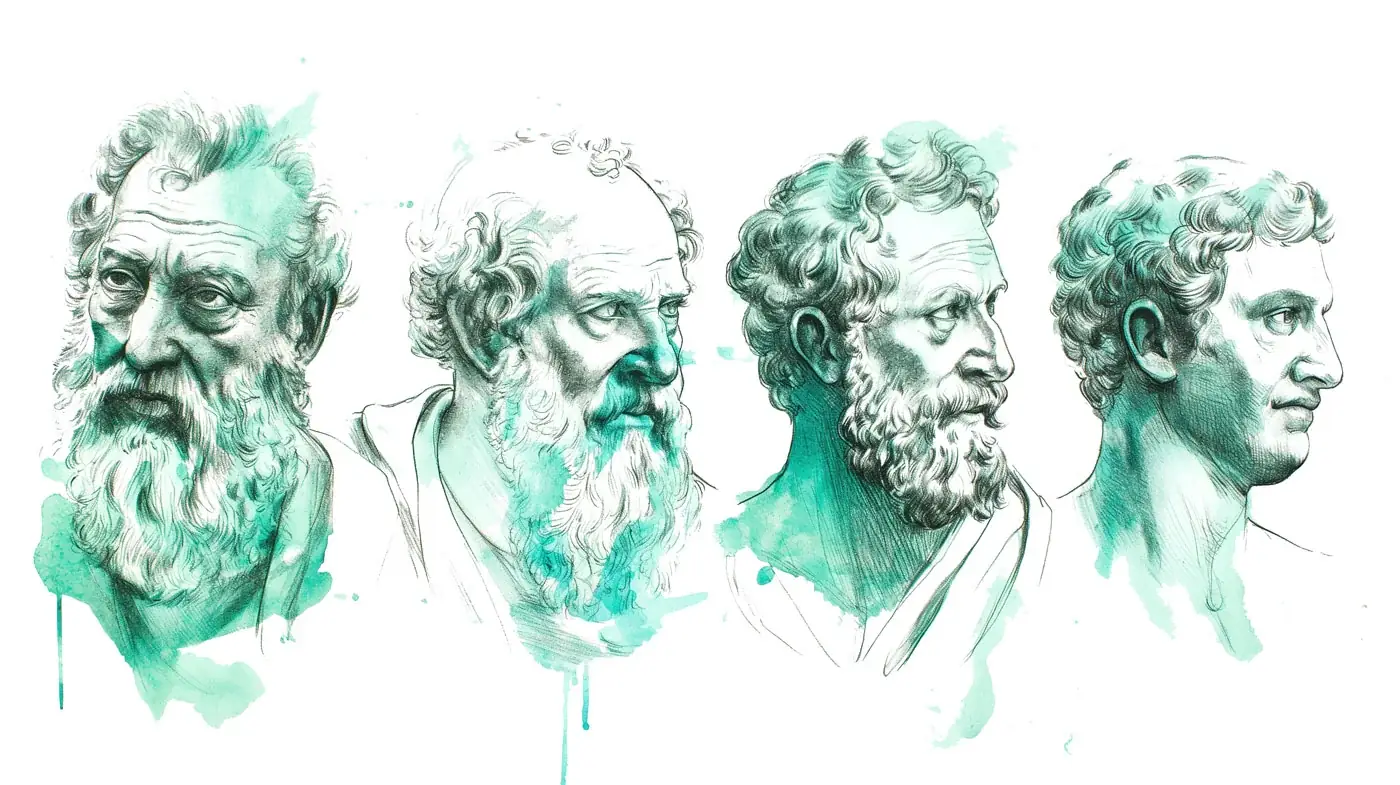
Long before learning management systems and data analytics existed, ancient philosophers — Confucius, Socrates, Plato, and Aristotle — examined questions that remain central to learning design today: How do people truly learn? What conditions foster understanding? How do we create transformative educational experiences?
Confucius: The Power of Community-Centered Learning
Confucian philosophy challenges individualistic learning approaches, recognizing that learning emerges from connections, relationships, and community engagement.
Implications for Learning Experience Design
- Design for connection, not consumption: Create social learning opportunities — peer review activities, collaborative problem-solving, and community discussion spaces.
- Embrace differentiated pathways: Teaching must adapt to individual learner needs through adaptive pathways and flexible pacing.
- Focus on character development: Incorporate reflection activities and ethical case studies beyond knowledge acquisition.
- Guide from the side: Experts prompt discovery rather than deliver information.
Social Learning Theory (Bandura), Communities of Practice (Wenger), Collaborative Learning Theory, Situated Learning Theory (Lave & Wenger).
Socrates: The Art of Transformative Questioning
The Socratic method remains powerful for creating deep learning experiences that require active engagement with ideas and questioning preconceptions.
Implications for Learning Experience Design
- Build in cognitive dissonance: Design activities that surface assumptions, present conflicting information, or pose problems requiring new approaches.
- Design for dialogue: Create structured opportunities for meaningful dialogue about concepts, applications, and implications.
- Question-driven architecture: Organize learning experiences around essential questions that drive inquiry and discovery.
- Embrace uncertainty: Design experiences helping learners become comfortable with ambiguity.
Inquiry-Based Learning, Problem-Based Learning (PBL), Critical Thinking Pedagogy (Freire), Transformative Learning Theory (Mezirow).
Plato: Building Understanding Through Gradual Ascent
Plato’s concept of gradual ascent — progressing through increasingly sophisticated understanding levels — directly anticipates modern scaffolding techniques and Vygotsky’s zone of proximal development.
Implications for Learning Experience Design
- Scaffold complexity: Design progressions that gradually increase complexity. Start with concrete examples before abstract concepts.
- Awaken inner knowledge: Design experiences helping learners discover connections and insights rather than receive information.
- Balance different ways of knowing: Engage multiple dimensions — analytical thinking, emotional engagement, and practical application.
- Universal design principles: Design learning experiences accessible and meaningful for diverse learners.
Zone of Proximal Development (Vygotsky), Scaffolding Theory (Wood, Bruner, Ross), Bloom’s Taxonomy, Universal Design for Learning (UDL).
Aristotle: Understanding the “Why” Behind Learning
Aristotle’s emphasis on causation and deeper understanding pushes designers beyond surface engagement to help learners grasp underlying principles.
Implications for Learning Experience Design
- Design for transfer: Create opportunities for learners to apply knowledge in varied contexts.
- Connect learning to purpose: Help learners understand not just what they’re learning, but why it matters.
- Build mental models: Design activities helping learners construct coherent understanding frameworks.
Transfer Theory, Cognitive Load Theory, Self-Determination Theory, Meaningful Learning Theory (Ausubel).
Integrating Classical Wisdom into Modern Practice
These five themes cut across all four philosophers and remain directly actionable in contemporary LXD:
- Relationship-centered design: Learning is fundamentally social — design for meaningful connections.
- Inquiry-driven experiences: Structure learning around compelling questions and problems.
- Gradual complexity: Build experiences scaffolding learners from concrete to abstract.
- Holistic development: Address knowledge, skills, values, character, and wisdom.
- Reflective practice: Build regular opportunities for learners to examine assumptions.
The wisdom of classical thinkers reminds us that the most important innovations in learning often come not from new technologies, but from deeper insights into timeless patterns of human learning and growth.
Key Questions Answered
The most commonly asked questions about this topic, concisely answered.
- Classical philosophy laid many of the conceptual foundations that modern LXD builds on. Socrates' dialogical method anticipates inquiry-based and problem-based learning. Plato's gradual ascent from concrete to abstract maps to scaffolding and Vygotsky's ZPD. Aristotle's emphasis on practice and habit prefigures experiential learning and deliberate practice theory. Confucius' community-centered learning aligns with communities of practice and social learning theory.
- The Socratic method is a form of dialogue in which a skilled questioner leads learners to examine their assumptions, surface contradictions, and arrive at deeper understanding through guided inquiry. In LXD, Socratic design involves building question-driven architectures, creating activities that surface cognitive dissonance, designing branching scenarios where choices reveal hidden assumptions, and facilitating structured dialogue rather than lecture-based delivery.
- Confucian philosophy positions learning as inherently social — knowledge is developed through relationships, dialogue, and community engagement rather than individual study alone. This perspective anticipates Etienne Wenger's Communities of Practice, Vygotsky's sociocultural theory, and collaborative learning models. Confucius also emphasized differentiated teaching — adapting instruction to the individual learner's character, needs, and context.
- Plato's Allegory of the Cave and the concept of gradual ascent describe how learners progress from surface-level perception and imitation toward deeper, abstract understanding — a movement that requires deliberate guidance. This maps directly onto modern scaffolding principles, Bloom's Taxonomy (moving from recall to synthesis and evaluation), and the idea that complex understanding cannot be rushed but must be built progressively.
- Aristotle emphasized that virtues and skills are developed through repeated practice — you become courageous by acting courageously, you become a skilled writer by writing. This principle directly prefigures experiential learning (Kolb), deliberate practice (Ericsson), and the LXD emphasis on learning-by-doing. Aristotle also introduced the distinction between theoretical knowledge (episteme), practical wisdom (phronesis), and craft knowledge (techne) — a framework still relevant for designing different types of learning objectives.
- The banking model was coined by Paulo Freire (drawing on Marxist and existentialist traditions), describing education as depositing knowledge into passive students. While not a classical philosopher himself, Freire's critique resonates with Socratic and Confucian traditions that view learners as active participants in knowledge construction — not empty vessels to be filled.
- In asynchronous eLearning, Socratic design can be approximated through:
- Branching scenario questions that surface assumptions and show consequences
- Reflective prompts requiring learners to articulate and defend positions before seeing expert perspectives
- Discussion forums structured around essential questions rather than content summaries
- Case studies presenting conflicting evidence that learners must weigh and resolve
- Phronesis, Aristotle's concept of practical wisdom, refers to the capacity to deliberate well and act rightly in specific, contextual situations — a form of judgment that cannot be reduced to rules or formulas. For learning designers, phronesis is the goal of much professional and leadership development: not just knowledge of what to do, but the wisdom to know what to do in this particular situation. Developing phronesis requires rich, contextual, reflective experience — not just content delivery.
- Yes. Classical philosophers wrote in specific historical and cultural contexts that carried significant limitations — including exclusion of women, enslaved people, and non-elite classes from the 'ideal' educational community. Modern LXD must adapt classical insights critically, combining their intellectual depth with contemporary commitments to equity, inclusion, accessibility, and evidence-based practice.
- Direct lineages include:
- Socrates → Inquiry-Based Learning, Problem-Based Learning, Transformative Learning Theory
- Plato → Scaffolding, Cognitive Apprenticeship, Bloom's Taxonomy
- Aristotle → Experiential Learning (Kolb), Deliberate Practice, Competency-Based Education
- Confucius → Social Learning Theory, Communities of Practice, Culturally Responsive Pedagogy
- Classical philosophy provides the intellectual roots of every modern learning theory. Understanding Socratic questioning improves your facilitation skills. Aristotle's emphasis on practice informs experiential design. Plato's structured progression maps to scaffolding. Studying these origins helps designers understand why modern frameworks work, not just how to apply them — making you a more thoughtful and adaptable practitioner.
- The Socratic method translates into modern learning through branching scenario questions that challenge assumptions, discussion forum prompts that require defending a position, coached reflection activities, and AI-powered tutoring systems that guide learners through questions rather than giving direct answers. The core principle — learning through guided questioning rather than information delivery — remains one of the most powerful instructional strategies available.